
Emerging NFC standard
iTAP — the intelligent NFC tap standard
iTAP is a new contactless standard that upgrades the NFC 'tap' — making selection of the right card or credential at a smart terminal faster and more reliable. Driven by an industry consortium of chip, handset and payment companies, it runs on the same 13.56 MHz NFC layer as the rest of the contactless ecosystem, so it can be developed and pre-tested on the ci230 today.
What is iTAP?
iTAP is an emerging near-field interaction standard that improves the NFC 'tap' experience. Its focus is the fast, unambiguous selection of the right card or credential when a phone or smart terminal holds several — so a single tap reliably completes a payment, opens a gate or triggers a service, rather than a multi-step scan-a-QR-code flow.
It is driven by the Intelligent Terminal Microelectronics Association (ITMA) — an industry consortium spanning chip makers, handset vendors and payment providers, including names such as Huawei, Ant Group (Alipay) and China UnionPay. It is positioned as an open industry standard, with an international-adoption track under discussion.
How iTAP relates to NFC
iTAP builds on standard 13.56 MHz NFC — the same physical layer as ISO/IEC 14443, EMV® contactless and NFC Forum. It does not replace that RF foundation; it adds an intelligent selection and interaction layer above it, working with the device's secure hardware (secure element and eSIM).
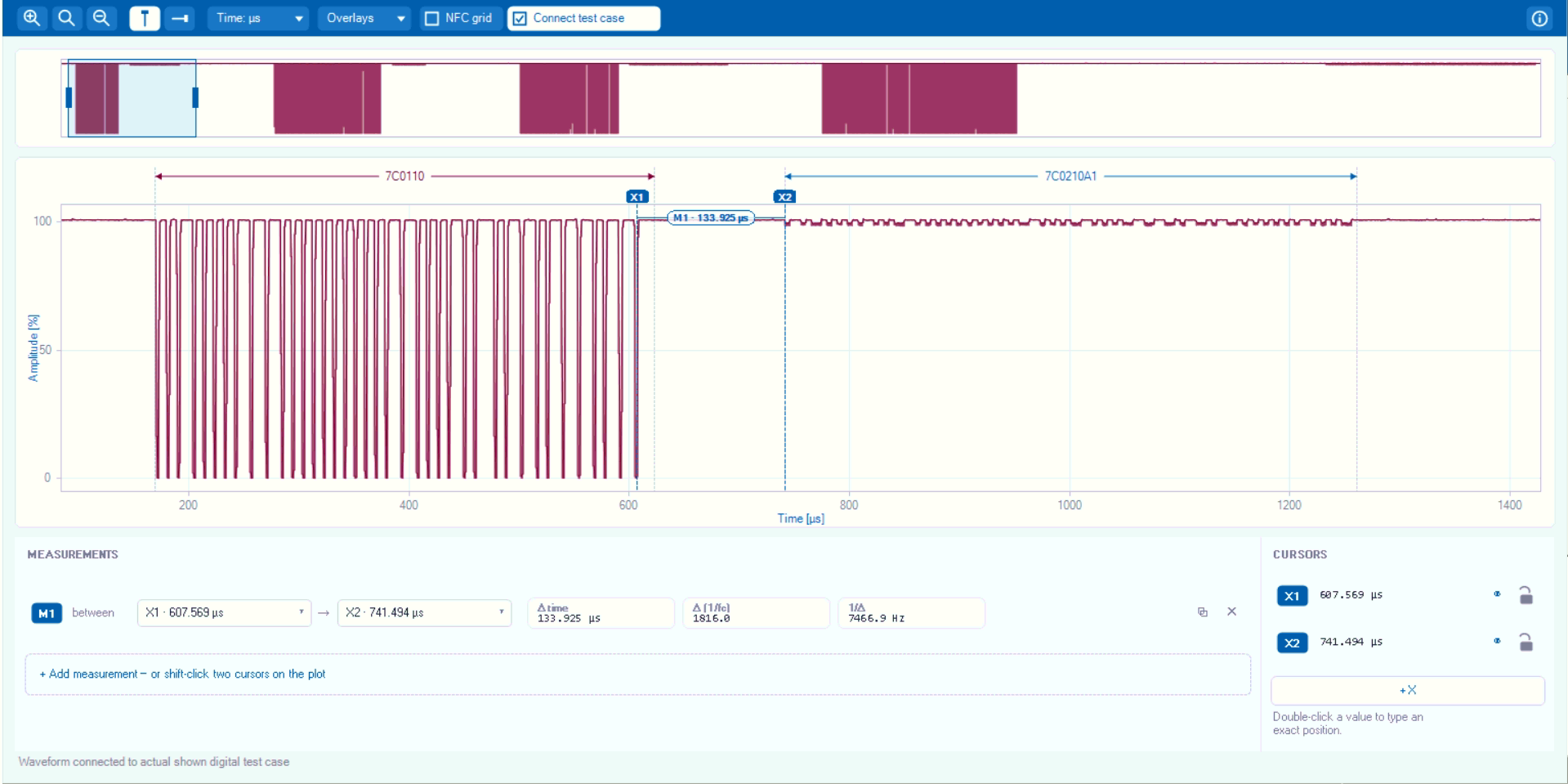
Because the analog and low-level digital behavior is NFC at 13.56 MHz, iTAP is measured with the same class of methods — field strength, load modulation, waveform and timing, and the low-level protocol — that already underpin ISO 10373-6, EMV® and NFC Forum testing.
What iTAP testing covers
On the ci230, iTAP testing spans the analog, access and application layers — on one platform:
- Analog — There are no official iTAP analog test cases today. The ci230 closes that gap: customize the ISO 10373-6 PICC analog test suite to fit the iTAP protocol and get a complete analog qualification of your DUT. Analog testing runs on the same platform as your protocol tests, with no extra equipment and no separate toolchain.
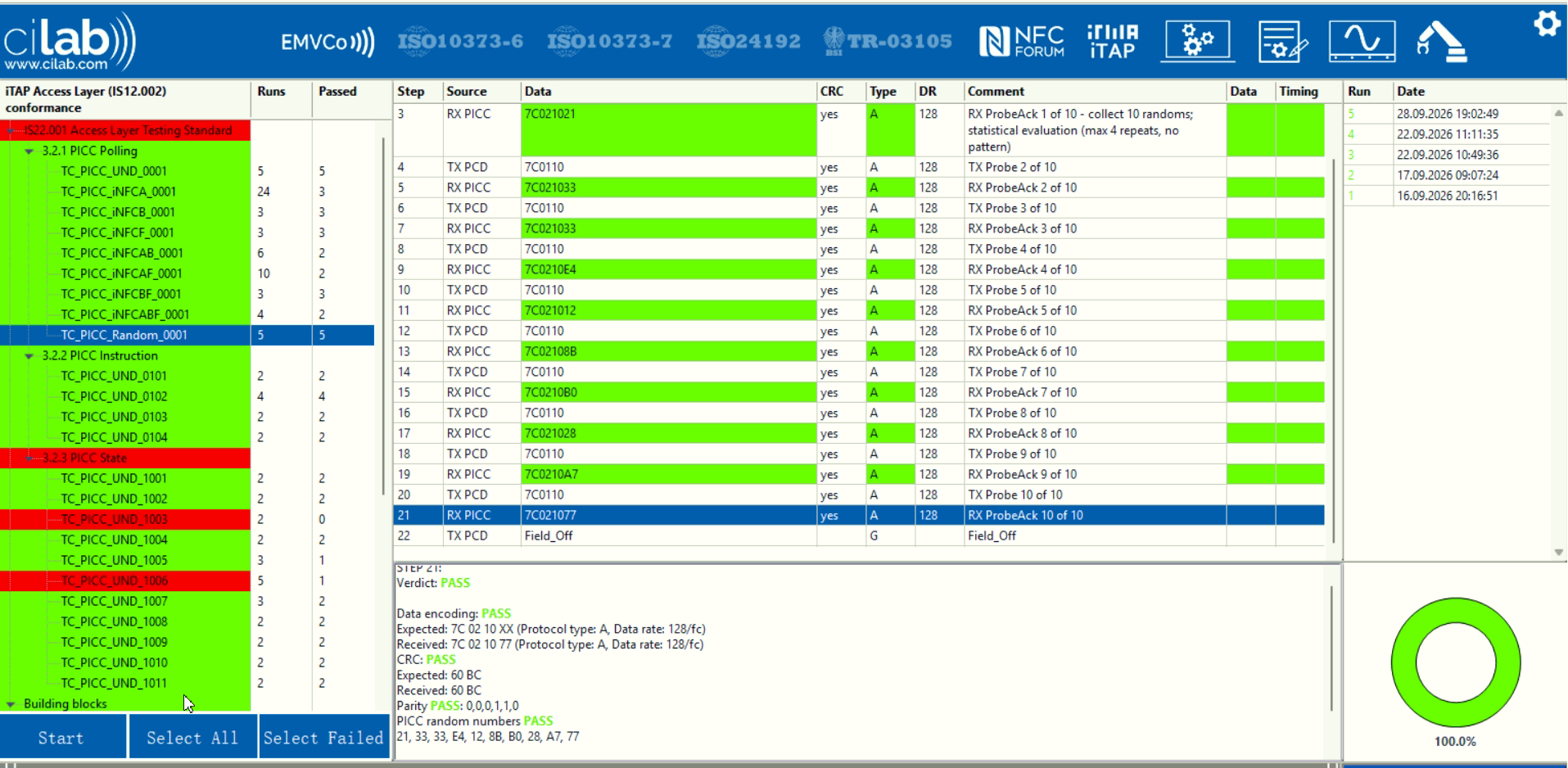
- Access layer — iTAP extends ISO/IEC 14443-3 with richer control commands, so an iTAP device in PICC mode can recognize an iTAP reader and select the right card on its own. The ci230 validates this behavior on both sides, whether you are building the card/device or the reader.
- Application layer — iTAP defines application behavior on top of automatic card selection and high-speed data transfer, such as basic tap, payment, digital ID and scenario-based “touch” use cases. The ci230 tests these flows end to end, so you can confirm that your PICC and PCD work together as intended.
- Built for debugging — Unmatched test speed and powerful debug capabilities help you find and fix issues quickly, from first prototype to qualified product.
Access and application layer: supported on both sides of the tap
Most iTAP behavior lives above the RF. The access layer decides whether a device recognizes an iTAP reader and picks the right card; the application layer decides whether the tap, payment or ID flow then completes. The ci230 supports both layers — not only the analog and ISO/IEC 14443 foundation underneath — so you can develop and pre-test complete iTAP behavior in your own lab.
- Building an iTAP card or device — the ci230 takes the reader's role and checks that your device, in PICC mode, recognizes an iTAP reader, selects the right card on its own and completes each application flow.
- Building an iTAP reader — the ci230 validates the same card selection and application flows from the card side.
- Testing both together — run the complete tap end to end, from activation and card selection through to the application exchange, on the same instrument as your analog qualification.
Test it with cilab
Develop and pre-test iTAP on the ci230
The ci230 already covers the 13.56 MHz NFC analog and digital layers that iTAP is built on, and decodes the protocol from a single test antenna — with no separate sniffer probe. With access- and application-layer testing for both the card/device and the reader side, plus full analog qualification through a customized ISO 10373-6 PICC suite, it is a complete bench for developing and pre-testing iTAP products — alongside your EMV®, NFC Forum and ISO 14443 work on the same instrument.
Explore the ci230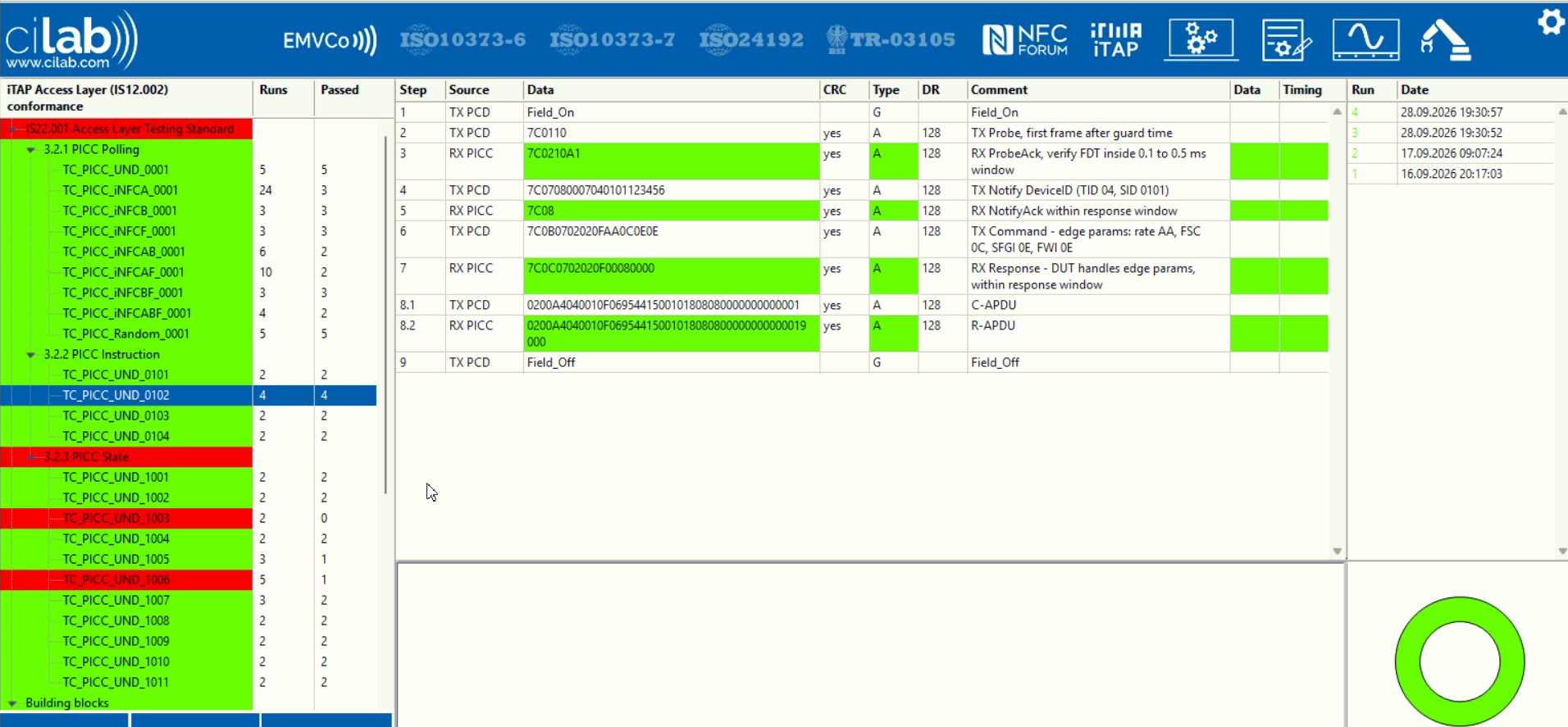
Frequently asked
What is iTAP?
iTAP is a new NFC 'tap' standard driven by the Intelligent Terminal Microelectronics Association (ITMA), an industry consortium of chip, handset and payment companies. It focuses on fast, accurate selection of the right card or credential during a contactless tap, on the standard 13.56 MHz NFC layer.
Is iTAP the same as Alipay Tap?
No. Alipay Tap is one consumer implementation built on top of the iTAP ecosystem; iTAP itself is the underlying industry standard, backed by a range of chip, handset and payment partners.
Does iTAP replace EMV® or NFC Forum?
No. iTAP builds on the same 13.56 MHz NFC layer and is complementary — a device can support iTAP alongside EMV® contactless and NFC Forum, and the ci230 tests them on one bench.
Are there official iTAP analog test cases?
Not yet — there are no official iTAP analog test cases today. The ci230 closes that gap by customizing the ISO 10373-6 PICC analog test suite to fit the iTAP protocol, so you get a complete analog qualification of your DUT on the same platform as your protocol tests.
Does the ci230 test the iTAP access and application layers?
Yes. It validates the iTAP access layer — the ISO/IEC 14443-3 extension that lets a device recognize an iTAP reader and select the right card on its own — and the application flows built on it, such as basic tap, payment and digital ID, for both the card/device and the reader side.
Can I pre-test iTAP in-house?
Yes. Because the ci230 runs the underlying NFC analog and digital measurements and decodes the protocol, you can develop and pre-test iTAP behavior in your own lab, on the same instrument as your other contactless work.
Related standards
NFC Forum certification
NFC Forum certification proves an NFC device interoperates with the rest of the ecosystem. CR15 is the current certification release, extending the tested operating range and consolidating the analog, digital and wireless-charging requirements.
Contactless standardISO/IEC 14443 proximity card testing
ISO/IEC 14443 is the foundation of contactless — the 13.56 MHz proximity standard behind payment cards, transit, eID and access. Almost every NFC and EMV® contactless product builds on it.
Payment certificationEMV® Level 1 contact & contactless testing
EMV® Level 1 is the physical and protocol layer of payment — the analog and low-level digital behavior every payment card, terminal and phone must pass before type approval, on both the contact (ISO 7816) and contactless (RF) interfaces.
Test smart. Certify easy.
See how cilab runs iTAP on your bench — book a demo with one of our engineers.
Request a demo